 By
By EcoRid provides a seamless, stress-free property experience for London and Surrey residents, including Kingston and Epsom. Beyond standard cleaning, we offer complete solutions—from professional home moving and eco-friendly waste disposal to expert end of tenancy cleaning, patio cleaning, and handyman support.
Britain has a waste problem — and the numbers make uncomfortable reading. Despite decades of recycling campaigns, kerbside collections, and environmental pledges, the UK’s approach to waste and waste disposal remains stubbornly stuck in the past. The gap between ambition and reality has never been more stark.
In the 2024/25 financial year, households in England alone generated approximately 21.9 million tonnes of waste — yet the national recycling rate sat at just 43.7%.
That figure isn’t merely disappointing. It’s a warning signal. The government’s target is to recycle 65% of municipal waste by 2035, which means the UK must close a 21-percentage-point gap in roughly a decade. At the current trajectory, that target looks less like an ambition and more like a wish.
The uncomfortable truth is that ‘business as usual’ is failing. Waste is collected, transported, and — too often — quietly redirected to landfill or incineration under the cover of vague disposal language. Households and businesses believe they’re doing the right thing, yet the systems meant to support those choices frequently fall short. As Green Alliance highlights, much of the waste in our economy never reaches genuine recovery at all.
What’s needed isn’t incremental improvement — it’s a fundamental shift in mindset. A ‘Recycle First’ mandate places diversion from landfill and verified material recovery at the absolute centre of every disposal decision, rather than treating recycling as an afterthought once cheaper options have been exhausted.
The question is: what does genuinely ethical disposal actually look like — and how do you know when a provider is truly delivering it?
What is Eco-Friendly Waste Disposal? (And What It Isn’t)
The previous section exposed a hard truth: recycling rates in the UK have flatlined, and much of the problem lies in how the industry defines “eco-friendly” in the first place. Sustainable waste management isn’t a marketing badge — it’s a measurable operational standard. And far too many providers fall well short of it.
The 5 Rules of Zero Waste in a Commercial Context
Genuine zero-waste practice in a commercial setting follows five non-negotiable principles:
-
Reduce at source — minimise waste generation before collection begins
-
Reuse wherever possible — extend the life of materials before processing
-
Recycle through verified channels — not just “divert from landfill”
-
Recover energy from materials that cannot be recycled
-
Dispose responsibly — landfill is always the absolute last resort
Each rule builds on the last. Skip one, and the entire chain breaks down.
‘Diversion from Landfill’ vs. True Recycling
Here’s where the greenwashing often hides. Diversion from landfill simply means waste didn’t go directly to a landfill site — it could still be incinerated, stockpiled, or exported. True recycling means materials are actively processed and re-entered into the supply chain as usable resources.
A company that claims eco-credentials must demonstrate where materials go after collection — not just where they don’t go.
What a Company Must Prove to Earn the ‘Eco’ Label
An honest eco promise requires documented evidence. That means transporting collected items to professional transfer stations where wood, metal, and plastic are properly sorted, baled, and directed to specialist processing plants. Vague commitments without audit trails don’t qualify.
Greenwashing Red Flags — A Quick Checklist
Watch out for these warning signs when evaluating any waste provider:
-
❌ No documentation of where waste ultimately goes
-
❌ Claims of “100% landfill-free” without verified transfer station data
-
❌ No mention of material sorting or baling processes
-
❌ Recycling rate figures without third-party confirmation
-
❌ Generic “eco-friendly” language with no operational detail
Understanding what separates a genuine commitment from a hollow promise is the first step. The next question is: what does genuinely responsible practice actually look like in action?
The Ecorid Promise: A ‘Recycle First’ Operational Reality
Understanding what “ethical waste disposal” means in practice requires looking beyond policy statements and into the actual journey of a collected item. This is where the eco promise moves from marketing language into measurable operational reality.
The Journey of Your Waste: From Collection to Circular Use
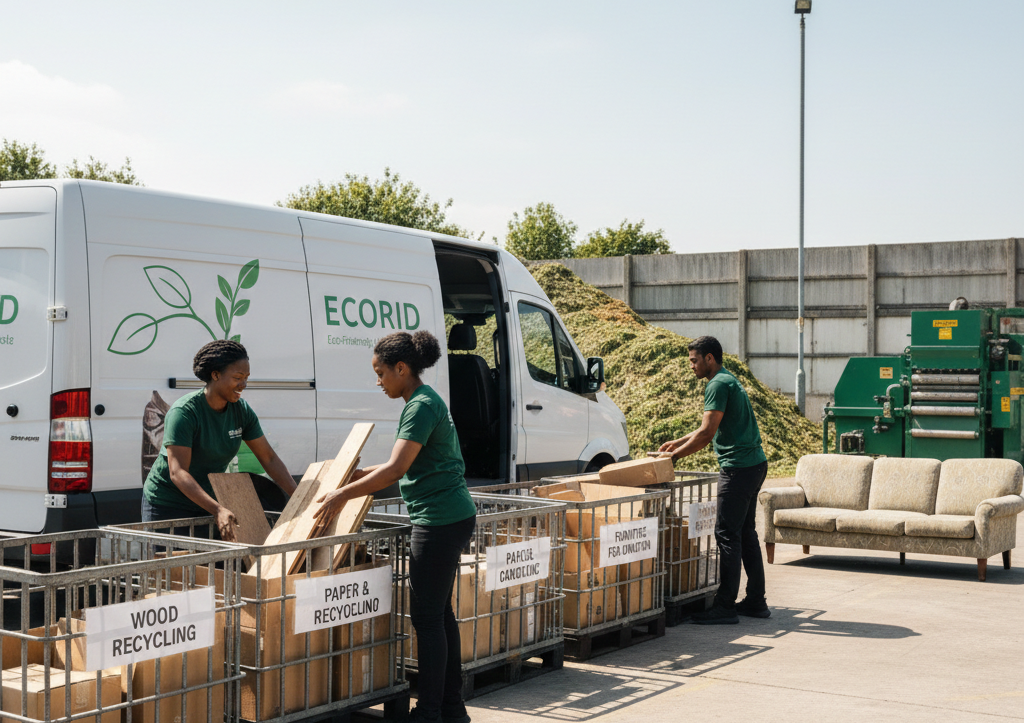
Step 1 — Collection and Sorting. When a skip or clearance load arrives at a licensed facility, materials are immediately separated by category rather than simply tipped into a general waste stream. This initial triage is critical; it’s the point at which valuable resources are either saved or lost permanently.
Step 2 — Material-Specific Processing. Each category follows its own dedicated pathway. Old timber from garden fences and decking — the kind of material most services would send straight to landfill — is processed into either biomass fuel or wood chips. Those wood chips are then channelled into landscaping, equestrian surfaces, or energy generation. Cardboard and plastics, meanwhile, are baled using industrial compaction equipment, creating dense, standardised bundles that specialist recycling facilities can accept and reprocess efficiently.
Step 3 — Verified Diversion from Landfill. Only materials that cannot be repurposed through any viable pathway reach disposal. This isn’t a target or an aspiration — it functions as a non-negotiable operational constraint built into the process from the outset.
Why ‘Recycle First’ Matters Beyond Good Intentions
A common pattern in waste management is what might be called the convenience gap: materials that could be recycled end up in landfill simply because separating them takes more time and infrastructure. Closing that gap requires structural commitment, not goodwill.
The broader relevance here connects directly to the UK’s circular economy ambitions. The Green Alliance’s research highlights that waste reduction must be embedded throughout supply chains — not treated as an afterthought at the point of disposal. A waste removal service that routes timber into fuel and plastics into baled recycling is, in a small but genuine way, participating in that systemic shift.
The most meaningful environmental action isn’t the one that’s visible — it’s the one that happens after the lorry drives away.
That systemic accountability extends in another direction, too. Choosing how your waste is handled also carries legal weight — something the next section addresses directly.
The Hidden Cost of Waste Crime: Protecting Your Property and the Planet
Choosing the wrong waste carrier isn’t just an environmental gamble — it’s a legal one. Many householders remain unaware that under UK law, they carry a Duty of Care for their waste from the moment it leaves their property until it reaches a legitimate disposal facility. That responsibility doesn’t vanish the moment a lorry pulls away.
“There’s nothing to stop any pollutants being washed into nearby rivers or soils at illegal waste sites.” — Prof Kate Spencer, Landfill Expert, Queen Mary University of London
The environmental consequences of using an unverified carrier can be severe. When waste ends up at an illegal site, hazardous materials — household chemicals, old electronics, construction debris — leach directly into surrounding soil and waterways with zero regulation or oversight.
What You’re Actually Risking
Opting for a suspiciously cheap quote might feel like a savvy saving, but the potential costs are significant. Under the Environmental Protection Act 1990, householders who fail to verify their waste carrier can face:
-
Fines of up to £5,000 in a magistrates’ court for fly-tipping-related offences
-
Unlimited fines in the Crown Court for serious breaches
-
A formal criminal record, which can affect property sales and professional licences
-
Liability for clearance costs if fly-tipped waste is traced back to your address
A common pattern is that budget operators — sometimes no more than a van and a mobile number — collect waste and dump it illegally, leaving the original householder exposed. The short-term saving of £50 or £60 can spiral into thousands in legal fees and fines.
Ecorid operates as a fully registered waste carrier, providing verifiable documentation and a transparent chain of custody for every collection. Much like how concepts such as the ecover refillery model accountability around product lifecycle, responsible waste disposal demands that every step of the journey is traceable and documented.
Protecting your property and the planet starts with knowing who is handling your waste — and where it’s actually going. That question of “where” becomes even more interesting when you consider how the logistics of getting waste removed can themselves be redesigned to reduce environmental harm.
The ‘One-Stop Shop’ Model: Slashing Carbon Through Integrated Logistics
Most property transitions involve a familiar, inefficient parade: a cleaning crew arrives in one van, removal specialists follow in another lorry, and a separate waste carrier turns up to collect what’s left behind. Three vehicles. Three sets of fuel costs. Three times the road emissions — for a single property move.
This fragmented approach is the default model, but it’s far from the only one.
Eco-friendly waste disposal doesn’t begin at the kerb — it begins with the decision about how services are organised. By combining home relocation, deep cleaning, and rubbish removal into a single coordinated visit, Ecorid ensures only one vehicle is dispatched instead of three, directly lowering fuel consumption and cutting associated carbon emissions significantly.
Traditional vs. Integrated: A Clear Comparison
| Traditional Model | Ecorid Integrated Model |
|---|---|
| 3 separate service providers | 1 coordinated team |
| 3 vehicle journeys per property | 1 vehicle dispatched |
| Disjointed scheduling and delays | Streamlined single visit |
| Higher combined cost | Consolidated, transparent pricing |
| Greater carbon output | Measurably reduced road emissions |
The logic is straightforward. Every unnecessary vehicle on the road burns petrol, contributes to congestion, and adds to a property transition’s overall carbon footprint. Consolidating logistics isn’t just convenient — it’s a structural reduction in environmental impact.
What’s particularly compelling about this model is that efficiency and sustainability reinforce each other rather than compete. Fewer journeys mean lower overheads, faster turnarounds, and less disruption for householders and landlords alike. In practice, this positions integrated property services as a genuine command centre for modern, responsible property management.
The carbon case is made through operational design, not just intention. And as we’ll explore in the next section, this streamlined approach serves a remarkably diverse range of clients — from tenants protecting their deposit to small businesses managing ESG commitments.
Eco-Friendly Waste Disposal for Everyone: Tailored Solutions
Responsible waste management isn’t a luxury reserved for large organisations with dedicated sustainability teams. A Recycle First policy makes ethical disposal accessible to every household, landlord, business, and tenant — and understanding how it applies to your specific situation is the first step towards genuinely greener choices. EcoRid – The Trusted Junk Removal Service in the UK
Homeowners
Clearing a garage or tackling an overgrown garden produces a surprisingly varied mix of waste — old furniture, broken tools, garden refuse, and general junk accumulated over years. In practice, a professional clearance service that prioritises recycling and reuse transforms what feels like an overwhelming task into a stress-free, environmentally responsible process, handled in a single visit.
Landlords
Void periods cost money, so rapid property turnarounds between tenants are essential. Ecorid’s seamless, all-in-one approach — combining furniture delivery and junk removal in a single service — means landlords can clear, refresh, and restock a property ethically without coordinating multiple contractors or compromising on responsible disposal standards.
Small Businesses
For small businesses navigating growing ESG expectations, compliant office clearances and ongoing waste management are no longer optional extras. A structured, documented recycling approach provides the paper trail needed to satisfy stakeholders and demonstrate genuine environmental accountability.
Tenants
End-of-tenancy clearing is one of the most common reasons deposit deductions occur. Professional removal of unwanted items — disposed of responsibly rather than left kerbside — leaves a property in pristine condition, protecting your deposit and leaving a positive impression for the next occupant.
Whoever you are, the path to cleaner, more ethical waste disposal starts with a single decision — one the concluding section will help you take with confidence.
Key Takeaways
-
❌ No documentation of where waste ultimately goes
-
❌ Claims of “100% landfill-free” without verified transfer station data
-
❌ No mention of material sorting or baling processes
-
❌ Recycling rate figures without third-party confirmation
-
❌ Generic “eco-friendly” language with no operational detail
Conclusion: Joining the Circular Economy Movement
Every clearance, every move, every declutter is a choice — between contributing to landfill and leaving a meaningful legacy. The integrated, Recycle First approach explored throughout this article demonstrates that ethical waste disposal isn’t complicated; it simply requires the right partner and the right priorities.
The UK recycling targets are clear: 65% recycling by 2035. Reaching that benchmark demands collective action, not passive hope. Responsible disposal is no longer optional — it’s the defining standard of ethical property management.
Ready to be part of the solution? Book your free ‘Recycle First’ con